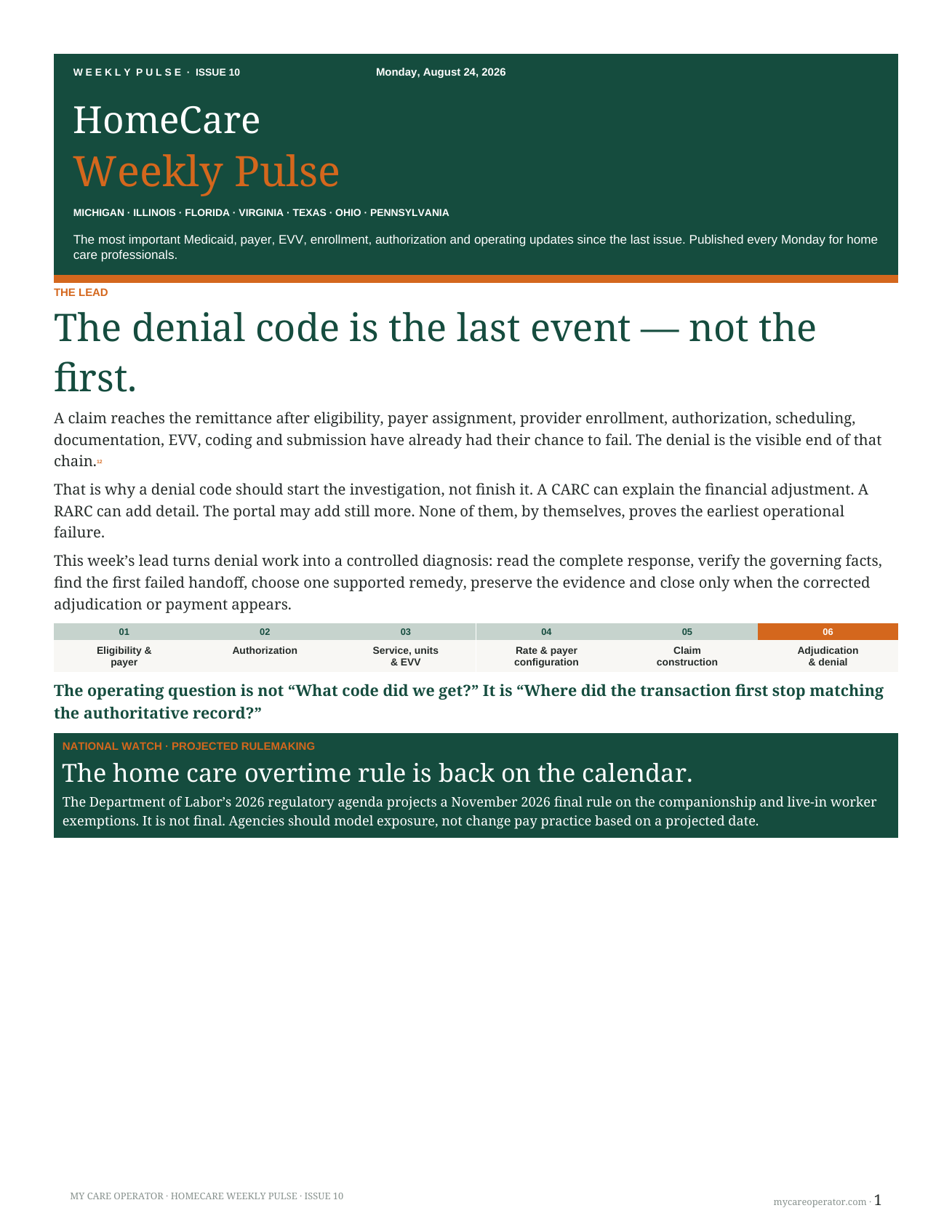
The denial code is the last event—not the first.
A claim reaches the remittance after eligibility, payer assignment, provider enrollment, authorization, scheduling, documentation, EVV, coding and submission have already had their chance to fail. The denial is the visible end of that chain.12
That is why a denial code should start the investigation, not finish it. A CARC can explain the financial adjustment. A RARC can add detail. The portal may add still more. None of them, by themselves, proves the earliest operational failure.
This week's lead turns denial work into a controlled diagnosis: read the complete response, verify the governing facts, find the first failed handoff, choose one supported remedy, preserve the evidence and close only when the corrected adjudication or payment appears.
The home care overtime rule is back on the calendar.16
The Department of Labor's 2026 regulatory agenda projects a November 2026 final rule on the companionship and live-in worker exemptions. It is not final.
Model exposure. Do not change pay practice from a projected date.
The fastest route to cash is the earliest failure.
Use the same six-step sequence for every denial. The point is not to make every claim follow the same remedy. It is to make every remedy follow a documented diagnosis.
Capture the group code, CARC, RARC, portal message, claim status and payer correspondence—not only the one-line denial label.
Check eligibility, payer assignment, enrollment, authorization, units, EVV, documentation, claim data and filing rules.
A later denial may be only the symptom produced by an earlier eligibility, authorization, routing or visit problem.
Correct, replace, void and rebill, resubmit, document, dispute, appeal or escalate based on evidence.
Keep the original response, screenshots, confirmation numbers, filing proof, contacts and follow-up date together.
Repair the intake, payer mapping, authorization, schedule-to-EVV, claim edit or close-out control that allowed the failure.
Correct
The payer and underlying facts are right, but the claim data or transaction can be fixed.
Appeal / dispute
The payer appears wrong after the controlling facts and filing rules have been verified.
Hold & verify
A key fact is unresolved. More submission activity would add noise, duplicates or deadline risk.
One denial. One diagnosis. One documented next move. Repeated submission is not a resolution path.
The code combination still has to meet the operating record.
CARCs and RARCs are essential parts of the remittance record, but they still have to be reconciled to the payer portal, eligibility, authorization, EVV and claim data.123
Authorization signal
The claim says authorization is missing.
Earliest failure
The authorization is valid, but the claim's modifier does not match the authorized service.
Supported move
Correct the claim data. An appeal would defend a claim that was built incorrectly.
Timely-filing signal
The payer says the filing window expired.
Earliest failure
The clearinghouse accepted the original transaction, but the payer portal does not show receipt.
Supported move
Preserve acceptance evidence, verify the payer's rule and dispute or appeal if the record supports it.
EVV signal
The claim denies for visit verification.
Earliest failure
The visit exists, but an unresolved exception prevented it from reaching matched or verified status.
Supported move
Resolve the exception, confirm the final EVV state and use the payer's supported correction path.
Medicaid Denial Diagnosis & Resolution Guide
Use the full desk reference in denial-review meetings and day-to-day billing work.
Two developments to model—not operationalize yet.
Neither item below changes today's Medicaid claim workflow. Both could materially change home care economics or benefit design if they advance.
The companionship exemption debate has moved back onto the federal calendar.16
The Department of Labor's 2026 unified agenda projects a November final rule on Fair Labor Standards Act exemptions for domestic-service workers employed by third parties. The underlying proposal would revisit the 2013 restrictions on the companionship-services and live-in domestic-worker exemptions.
The agenda describes competing effects: labor cost, consumer cost and Medicaid spending on one side; worker earnings, turnover, recruitment and access to care on the other. The timing is projected, and the substance is not final.
- Model scenarios by service line, state, payer and overtime concentration.
- Identify contracts or rate structures that would not absorb a labor-cost change.
- Keep compliance decisions with qualified labor counsel and the final governing rule.
A Medicare personal-care proposal would be separate from today's home health benefit.17
The Medicare at Home Act proposes a new Part B personal-care benefit of up to 20 hours per week for qualifying beneficiaries. The bill text treats the service as distinct from the existing Medicare home health benefit.
It is proposed legislation—not an enrollment path, coverage rule or billing opportunity. The useful signal is strategic: federal policymakers are again debating whether ongoing personal care belongs inside Medicare's benefit structure.
MICHIGAN — Transition protection does not remove the need to reconcile the receiving payer.45
Program lane: MI Choice ↔ MICH transitions. These letters do not change unrelated Home Help or managed-care claims.
Michigan is allowing service continuity during 2026 transitions between MI Choice and the Medicare Integrated Care for Home Health program. The state says providers may continue services and receive reimbursement even when delivery occurs before the receiving entity finishes authorization.
That protection does not tell an agency whether the receiving entity has loaded the provider, service, hours, effective date and claim route correctly.
- Build a MI Choice/MICH transition roster with prior payer, receiving payer, enrollment date, authorization status, service dates and claim status.
- Preserve outgoing and incoming records. Escalate missing transition data rather than waiting for a denial.
ILLINOIS — A $1.35 million sanction turns service-hour reductions into an evidence problem.6
Program lane: HealthChoice Illinois managed care; Persons with Disabilities and Persons who are Elderly waiver services. This is not a statewide stop-service order.
Illinois HFS sanctioned Meridian $1.35 million and required corrective action after finding problems in waiver service reductions, notices, person-centered records, informal-support documentation, supervisory review and appeal handling. HFS also imposed an enrollment hold effective August 22.
The enrollment hold does not direct existing providers to stop authorized services or stop billing. The immediate risk is a service schedule, authorization, notice or appeal record that no longer agrees with the others.
- Identify Meridian members with recent or pending hour reductions. Retain the current written authorization, notice, plan of care, appeal status and schedule together.
- Escalate conflicting instructions. Do not interpret member rights or promise an appeal outcome.
FLORIDA — Today's training should produce a transition exception list.789
Program lane: Children's Medical Services Plan transition to Molina. Unrelated SMMC, waiver and fee-for-service lanes remain separate.
Molina's Home Health Provider Training is scheduled for August 24. Current CMS Plan members transition to Molina on October 1, and Molina materials identify an HHAeXchange implementation for authorization, scheduling, EVV and billing workflows.
- Leave training with owners and due dates for contracting, roster and credentialing, member mapping, authorizations, HHAeXchange linkage, claim routing and first-payment validation.
- Treat attendance as a readiness test. The agency's internal completion date should be earlier than October 1.
VIRGINIA — Keep agency claims and consumer-directed payments in separate reconciliation lanes.1011
Program lane: CCC Plus waiver; agency-directed and consumer-directed services. Fiscal-agent payment is not an agency claim lane.
Virginia's July 1 rate updates remain an open reconciliation item. DMAS said managed-care loading may take 30 to 60 days after the August 13 posting, followed by automatic reprocessing approximately 30 days after plan systems are updated.
Consumer-directed services use a fiscal/employer-agent arrangement that varies by CCC Plus plan, while agency-directed services remain in the provider claim workflow.
- Maintain an agency-claim variance file by MCO, code and date of service. Keep consumer-directed attendant payment exceptions in a separate fiscal-agent queue.
- Close the July rate item only when the remittance and additional cash match the expected amount.
TEXAS — The activation email was the beginning. September 1 is the revenue deadline.1213
Program lane: STAR+PLUS · Community First Choice · fee-for-service. Map the portal and transaction path by program and payer.
TMHP sent the IAMOnline activation email on August 18. Separately, the EDI cutover from VPN connectivity to SFTP is scheduled for September 1, with mandatory batch testing through August 31. Providers that have not migrated risk interruptions to batch claims, eligibility, claim status and remittance transactions.
A successful portal login does not prove that a clearinghouse, billing vendor or internal batch process can send and receive the revenue transactions the agency depends on.
- Activate primary and backup users and confirm multifactor access to each required application.
- Require evidence of an end-to-end batch test: outbound file, acknowledgment, status response and inbound ERA path.
- Keep STAR+PLUS, CFC and fee-for-service routes distinct in the cutover tracker.
OHIO — Statewide rollout is complete. The remaining work is exception resolution.14
Program lane: Ohio HCBS · managed care · Next Generation MyCare. Resolve at the member, authorization and transaction level.
Next Generation MyCare completed its statewide rollout on August 1. The useful question is which members, authorizations, EVV records and claims still do not agree after transition.
No new broad statewide home care billing directive was identified in the August 17–22 review window. The Pulse is not manufacturing a second announcement.
- Reconcile member assignment, waiver authorization, EVV, payer ID, 277CA status, ERA/EFT and first clean payment in one exception file.
- Close an exception only after the transaction and payment path works for the affected member and service.
PENNSYLVANIA — August eligibility outreach is starting before the January 2027 rules.1518
Program lane: Community HealthChoices · OLTL · PROMISe. Eligibility notices apply by eligibility category, not by agency assumption.
Pennsylvania says current Medicaid expansion recipients will begin receiving mailings in August about work-requirement changes scheduled for January 2027. Monthly outreach is expected through the end of 2026.
Many people receiving HCBS may be outside the affected expansion category or may qualify for an exemption. An agency should not determine either.
- Train intake, scheduling and billing staff to recognize the notice without interpreting eligibility or exemption status.
- Route member questions to Pennsylvania DHS or the member's official assistance channel; document the referral and recheck coverage.
- Keep CHC plan assignment, OLTL waiver records and fee-for-service/PROMISe claim routing in separate fields.
Put these on the operating calendar now.
Diagnose before you submit again.
Capture every code, message, status and attachment associated with the claim.
Reconcile payer, eligibility, authorization, units, EVV, documentation and filing rules.
Fix the first mismatch in the workflow—not only the last message in the remittance.
Correct, replace, void, resubmit, document, dispute, appeal or escalate based on evidence.
Require corrected adjudication or payment. A promise to reprocess is not closure.
Repeated submission is not a control.
A denial resent without diagnosis can create duplicates, obscure the history and consume the filing window. Protect cash by proving what failed, what authority controls the fix, what evidence supports it and what corrected result closed it.
The agencies that protect cash will know which claims share a root cause, which remedy each claim requires, what deadline governs it and what corrected outcome actually arrived.
Which denial category creates the most rework in your agency: eligibility, authorization, EVV, payer routing or timely filing?
— JB
Julio Barea · Publisher & Editor · My Care Operator
For news, educational and informational purposes only. Not legal, financial, tax, clinical, billing, regulatory or compliance advice. Operator actions are editorial recommendations, not official agency instructions. Verify material requirements with governing authorities, payers, contracts and qualified advisers.
1. CMS, Health Care Payment and Remittance Advice.
2. X12, Claim Adjustment Reason Codes and Remittance Advice Remark Codes.
3. Medicaid.gov, Electronic Visit Verification.
4. Michigan MDHHS, L 26-47, MICH and MI Choice continuity of care, Aug. 10, 2026.
5. Michigan MDHHS, L 26-48, MICH and MI Choice transition coordination, Aug. 10, 2026.
6. Illinois HFS, Meridian HealthChoice Illinois HCBS sanction, Aug. 14, 2026.
7. Molina Healthcare of Florida, CMS Plan Provider Training Schedule, Aug. 2026.
8. Florida AHCA, Children's Medical Services Plan transition to Molina.
9. Molina Healthcare of Florida, HHAeXchange implementation training, Aug. 2026.
10. Virginia DMAS, Waiver Rate Updates Effective July 1, 2026, Aug. 13, 2026.
11. Virginia DMAS, Consumer-Directed Services.
12. TMHP, IAMOnline Activation Email Sent August 18, 2026.
13. TMHP, EDI Connectivity Change Rescheduled for September 1, updated Aug. 18, 2026.
14. Ohio Medicaid, Next Generation MyCare program and provider resources.
15. Pennsylvania DHS, Medicaid Changes Coming in January 2027.
16. U.S. DOL, 2026 Unified Agenda; Application of the FLSA to Domestic Service.
17. Medicare at Home Act, introduced bill text, Aug. 2026.
18. Pennsylvania DHS, Community HealthChoices Operations Memos.