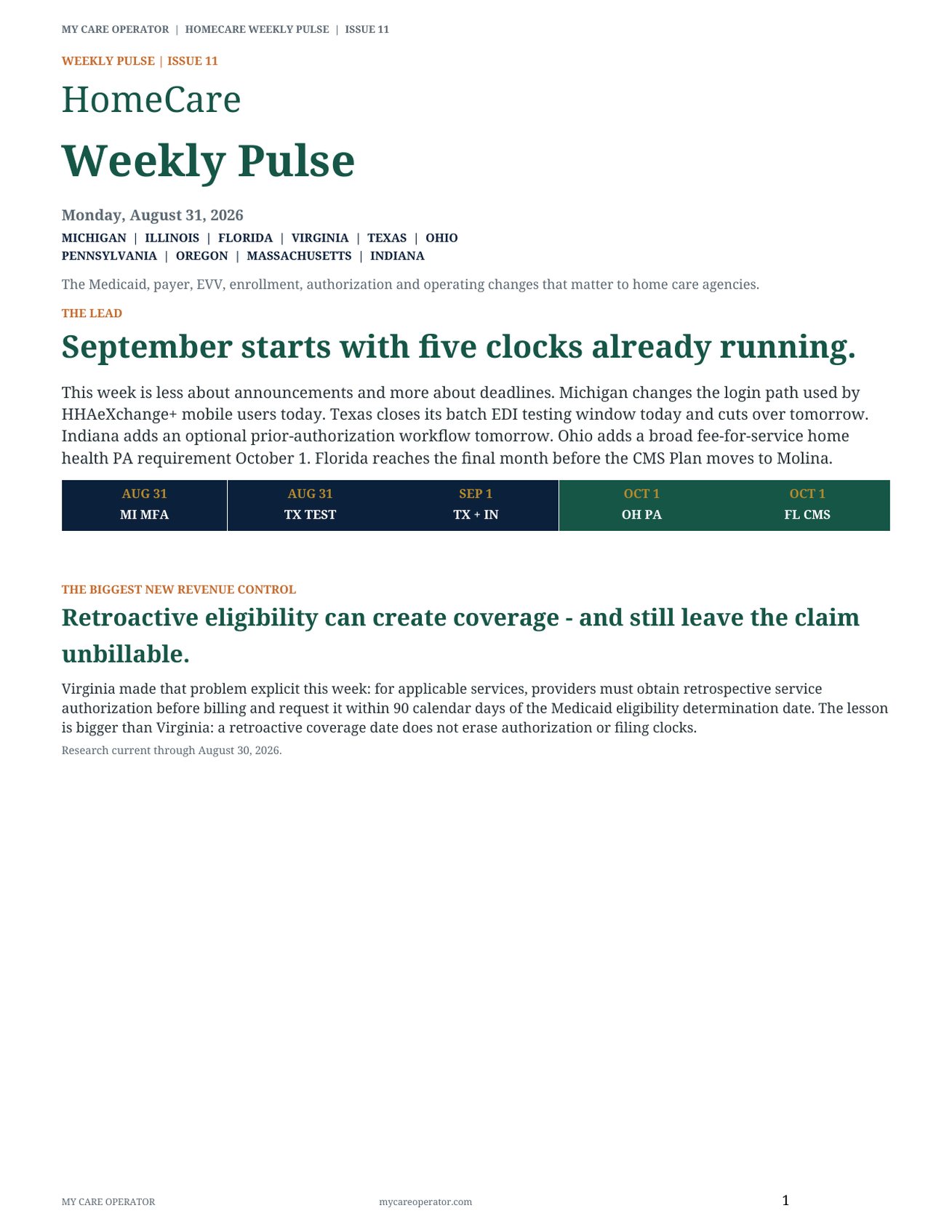
September starts with five clocks already running.
This week is less about announcements and more about deadlines. Michigan changes the login path used by HHAeXchange+ mobile users today. Texas closes its batch EDI testing window today and cuts over tomorrow. Indiana adds an optional prior-authorization workflow tomorrow. Ohio adds a broad fee-for-service home health PA requirement October 1. Florida reaches the final month before the CMS Plan moves to Molina.
The biggest new revenue control is Virginia’s retrospective-authorization rule for retroactive eligibility. For applicable services, providers must obtain service authorization before billing and request it within 90 calendar days of the Medicaid eligibility determination date.6
The lesson is bigger than Virginia: a retroactive coverage date does not erase authorization or filing clocks.
Five dates control a retroactive Medicaid claim.
Retroactive eligibility is one of the easiest places for an otherwise good billing team to lose cash. The member becomes eligible for an earlier period, so the claim suddenly looks billable. But coverage is only one control. Authorization, payer assignment and timely filing still have their own dates.
1 · Date of service
What was actually delivered?
Verify
Service, units, caregiver or clinician, documentation and EVV status where required.
Control
Do not let a later eligibility decision change the underlying service record.
2 · Coverage effective date
Was the member eligible for the date of service?
Verify
Program, delivery system and payer assignment for each affected date.
Control
Retroactive coverage can move this date backward; it does not settle authorization.
3 · Eligibility determination date
When did Medicaid actually determine eligibility?
Verify
Capture the determination notice and date as a separate field.
Control
A state may start a retrospective-authorization clock here. Virginia now uses 90 calendar days.6
4 · Authorization dates
Does the authorization cover the service?
Verify
Submission date, effective span, service, units, provider and governing entity.
Control
Retroactive eligibility does not automatically create authorization.
5 · Claim filing deadline
What date controls initial or corrected filing?
Verify
Initial filing, corrected claim, reconsideration and appeal rules can differ.
Control
Do not assume a retroactive eligibility decision extends every payer deadline.
The control
Put all five dates in one retro-coverage case record. If billing owns only the claim deadline and authorization owns only the approval, the agency can still miss the gap between them.
Turn retroactive coverage into a controlled work queue.
The safe workflow is not “eligibility changed, send the claim.” It is a short case-management process that proves every upstream requirement before submission.
Open a retro-coverage case immediately when retroactive or delayed eligibility appears. Record the determination date and source evidence.
List affected dates of service, service codes, units, program, payer and provider location. Keep unrelated service lanes separate.
Confirm the authoritative eligibility span and payer assignment for every affected date. Managed care rules may differ from fee-for-service.
Determine whether retrospective authorization is required, who controls it, how it is submitted and what deadline applies.
Release the claim only when required authorization and routing facts are supported. Track timely filing independently.
Close on adjudication and cash—not merely an authorization approval or a payer promise to reprocess.
Virginia is the live example.6
Effective August 24, DMAS says applicable services for a member approved for retroactive Medicaid eligibility require service authorization before billing. Providers must request retrospective authorization within 90 calendar days of the eligibility determination date. DMAS also says managed-care plans may use different guidelines under their contracts.
Portable principle: eligibility, authorization and timely filing are separate controls. Never import Virginia’s 90-day rule into another state. Do import the discipline of finding the correct clock before the claim moves.
MICHIGAN — MFA hits the HHAeXchange+ mobile app today. 1
Program lane: EVV — HHAeXchange+ mobile users across affected Michigan Medicaid EVV programs.
Beginning August 31, all HHAeXchange+ mobile app users must complete multi-factor authentication. Users can receive a code by text or email and repeat MFA every 30 days. MDHHS tells users to keep the email address in CHAMPS current. For agencies, a field-access problem can become a visit-capture and cash problem within a shift.
- Test caregiver login and code delivery before the first affected visit, not at clock-in time.
- Fix stale email/contact information and identify a support path for users who cannot receive the code.
- Track login failures separately from visit exceptions so an access problem is not misdiagnosed as EVV noncompliance.
ILLINOIS — No new broad statewide home-care directive identified this week. 23
Program lane: HealthChoice Illinois / HCBS / EVV. Keep prior exceptions only where they remain unresolved.
HFS provider notices show no new statewide home-care billing or EVV directive during the August 24–30 review window. Last week’s Meridian service-hour issue remains operational only for members whose authorization, notice, plan of care, schedule or appeal record still conflicts. HFS also maintains an MCO EVV-responsibility policy that can help diagnose stuck agency-based authorization/EVV handoffs, but it is not a new rule this week.
- Remove closed Meridian cases from the work queue.
- For open authorization/EVV mismatches, escalate the specific member and transaction with the supporting IMPACT, authorization and visit evidence.
- Keep the team focused on live exceptions.
FLORIDA — One month to Molina: move from training attendance to member-level readiness. 45
Program lane: Children’s Medical Services Plan transition to Molina. Other SMMC and fee-for-service lanes remain separate.
Current CMS Plan members transition to Molina on October 1. AHCA says existing appointments, prescriptions and prior authorizations will be honored. Molina’s provider schedule includes transition sessions during the final month. The useful test now is whether each affected member has a complete operational path—not whether someone attended a webinar.
- Reconcile the CMS member roster to Molina contracting/credentialing, existing authorization and service schedule.
- Confirm the HHAeXchange and claim-routing setup used by the agency for the affected service line.
- Set an internal completion date before October 1 and leave training with named unresolved exceptions.
VIRGINIA — Retroactive eligibility now starts a separate authorization clock. 6
Program lane: Virginia Medicaid — applicable services requiring service authorization; fee-for-service and managed care must be checked separately.
DMAS issued a new bulletin August 24 requiring retrospective service authorization before billing applicable services for members approved for retroactive Medicaid eligibility. The request must be made within 90 calendar days of the eligibility determination date; late requests are denied for timeliness. DMAS also reminds providers to verify eligibility at least monthly and says MCOs may use different guidelines under contract.
- Create a retro-eligibility queue keyed to the determination date, not just the retroactive coverage date.
- Before billing, verify whether the service requires retrospective authorization and which entity controls the request.
- Retain the eligibility determination, authorization submission proof and final authorization with the claim evidence.
TEXAS — Carry-forward because it matters: batch EDI testing ends today. 78
Program lane: TMHP batch EDI submitters using the legacy VPN path; real-time submitters are not the target of this cutover.
TMHP directs batch submitters to complete trading-partner testing by August 31, with the SFTP connectivity change scheduled for September 1. Separately, TMHP says the September 7 EFT distribution will be delayed one business day to September 8 because of fiscal-year close. The EDI risk is revenue-path continuity; the EFT notice is a cash-timing issue, not a denial.
- Require proof that the production SFTP path is ready—not only a successful portal login.
- Confirm outbound and inbound transactions with the clearinghouse, billing vendor or internal EDI owner and retain testing evidence.
- Adjust September 7–8 cash expectations for the announced one-business-day EFT delay where applicable.
OHIO — Every fee-for-service state-plan home health claim needs PA starting October 1. 9
Program lane: Ohio Medicaid state-plan home health fee-for-service. Applies to members including waiver participants.
A provider update published August 27 states that beginning October 1, all Ohio Medicaid state-plan home health fee-for-service claims require prior authorization. A 90-day grace period allows waiver-recipient claims that require PA to continue paying while case-manager coordination occurs; it is a transition window, not a permanent exemption.
- Inventory every FFS state-plan home health member and date of service that can cross October 1.
- Confirm the authorization owner, documentation and PNM submission path before the first affected service date.
- Treat the waiver grace period as time to complete the PA process—not permission to ignore it.
PENNSYLVANIA — Off-cycle revalidation is a provider-location risk, not routine paperwork. 10
Program lane: PROMISe enrollment / providers identified by DHS as high risk.
Pennsylvania added Medical Assistance Bulletin 99-26-06 on August 21 for off-cycle revalidation of high-risk providers. This is not a new revalidation deadline for every agency. It matters if DHS identifies a provider or service location for the off-cycle process.
- Make sure the enrollment/revalidation contact email and PROMISe service-location records are current.
- Route any off-cycle revalidation notice to a named owner the day it arrives; preserve submission and screening evidence.
- Review old overpayments, enrollment changes and other known screening issues before assuming the normal revalidation date controls.
INDIANA — Atrezzo adds an optional InterQual workflow September 1. 1112
Program lane: Indiana Medicaid fee-for-service prior authorization requests handled through Acentra Health / Atrezzo for applicable services.
Effective September 1, providers submitting Indiana Medicaid FFS prior-authorization requests through Atrezzo may choose an integrated InterQual workflow for applicable services. The workflow is voluntary and intended to improve submission completeness; it does not guarantee approval or replace Indiana’s governing review hierarchy.
- Decide whether the PA team will use the optional workflow and train accordingly.
- Use the workflow as a completeness check, not as an approval prediction or substitute for the governing Indiana rule.
- Do not confuse this with Indiana’s separate EDI+ modernization notice, which currently requires no trading-partner action.
MASSACHUSETTS — MassHealth changed the dual-eligible TPL instructions for home health. 13
Program lane: MassHealth home health agency billing — Appendix D, third-party-liability exceptions.
MassHealth Transmittal Letter HHA-60 revised the Home Health Agency Manual Appendix D, effective August 14. The change clarifies billing for dual-eligible Medicare and Medicaid members and updates the Third Party Appeals Unit contact information. This is a billing-desk change: the current manual needs to be the version the team actually uses.
- Replace saved or printed copies of Appendix D with the revised version.
- Review dual-eligible claim workflows and make sure billers are using the updated TPL exception instructions before correcting or appealing a claim.
- Update escalation/contact references so an old Third Party Appeals Unit path does not add avoidable delay.
OREGON — No material statewide home-care billing or EVV change identified this week. 14
Program lane: Oregon Medicaid LTSS / in-home services. Continue current program and payer controls.
The August 24–30 official-source review did not identify a new broad statewide Medicaid home-care billing, EVV or authorization directive that warrants changing an agency workflow this Monday. Oregon’s Agency with Choice option remains a newer 2026 program development, but it does not trigger a new billing control this week.
- Keep prior open enrollment, authorization, service and payment exceptions moving to closure.
- Do not change billing or EVV workflow based on the absence of a new notice; continue to use the governing program and payer sources.
- Escalate live member or transaction problems and close watch items that no longer have an active exception.
Put these on the operating calendar now.
Protect access, authorization and transaction flow before they become denials.
Prove field users can complete MFA before an EVV visit depends on it.
Get written evidence that the batch SFTP path is production-ready.
Open every retroactive-eligibility case with the determination date and authorization deadline.
Build the October 1 FFS home health PA inventory now.
Turn the CMS transition into a member-level exception roster.
Update the home health TPL desk guide for dual-eligible billing.
Decide whether the PA team will use the optional InterQual workflow.
Make off-cycle revalidation notices impossible to lose in a generic inbox.
The operating truth
Deadlines do not fail all at once. They fail at handoffs: the user who cannot authenticate, the authorization that was never opened, the payer route that was never tested, the provider notice that sat in an inbox. This week’s work is to make those handoffs visible before they become unpaid claims.
The strongest agencies will know which access, authorization, enrollment and transaction deadlines are live, who owns each one, what evidence proves completion and what result closes the item.
Which deadline could stop cash first in your agency this week: EVV access, authorization, enrollment, payer transition or EDI connectivity?
— JB
Julio Barea · Publisher & Editor · My Care Operator
For news, educational and informational purposes only. Not legal, financial, tax, clinical, billing, regulatory or compliance advice. Operator actions are editorial recommendations, not official agency instructions. Verify material requirements with governing authorities, payers, contracts and qualified advisers.
1. Michigan MDHHS, User Verification Updates are coming to the HHAeXchange Mobile App. MFA effective Aug. 31, 2026.
2. Illinois HFS, Provider Notices. Reviewed through Aug. 30, 2026.
3. Illinois HFS, Managed Care Program Policies — MCO-073 EVV Responsibilities.
4. Florida AHCA, CMS Plan Transition. Molina transition effective Oct. 1, 2026.
5. Molina Healthcare of Florida, CMS Plan Provider Training Schedule. Aug.–Sept. 2026 provider training schedule.
6. Virginia DMAS, Submitting Retrospective Service Authorization Requests for Retroactive Eligibility. Effective Aug. 24, 2026.
7. TMHP, EDI Connectivity Change Rescheduled for September 1, 2026. Batch SFTP cutover guidance.
8. TMHP, EFT Payments Delayed Due to Fiscal Year End. Aug. 25, 2026.
9. Buckeye Health Plan / Ohio Medicaid provider update, Home Health FFS Prior Authorization. Published Aug. 27, 2026; effective Oct. 1, 2026.
10. Pennsylvania DHS, Medical Assistance Bulletin 99-26-06 — Off-Cycle Revalidation of High-Risk Providers. Issued Aug. 21, 2026.
11. Indiana IHCP Bulletin BT2026142 — Atrezzo PA submission enhancement. Issued Aug. 25, 2026; effective Sept. 1, 2026.
12. Indiana IHCP Bulletin BT2026141 — EDI+ migration. Issued Aug. 20, 2026.
13. MassHealth Transmittal Letter HHA-60 — Revised Appendix D. Effective Aug. 14, 2026.
14. Oregon DHS, Agency with Choice. Current 2026 program information.