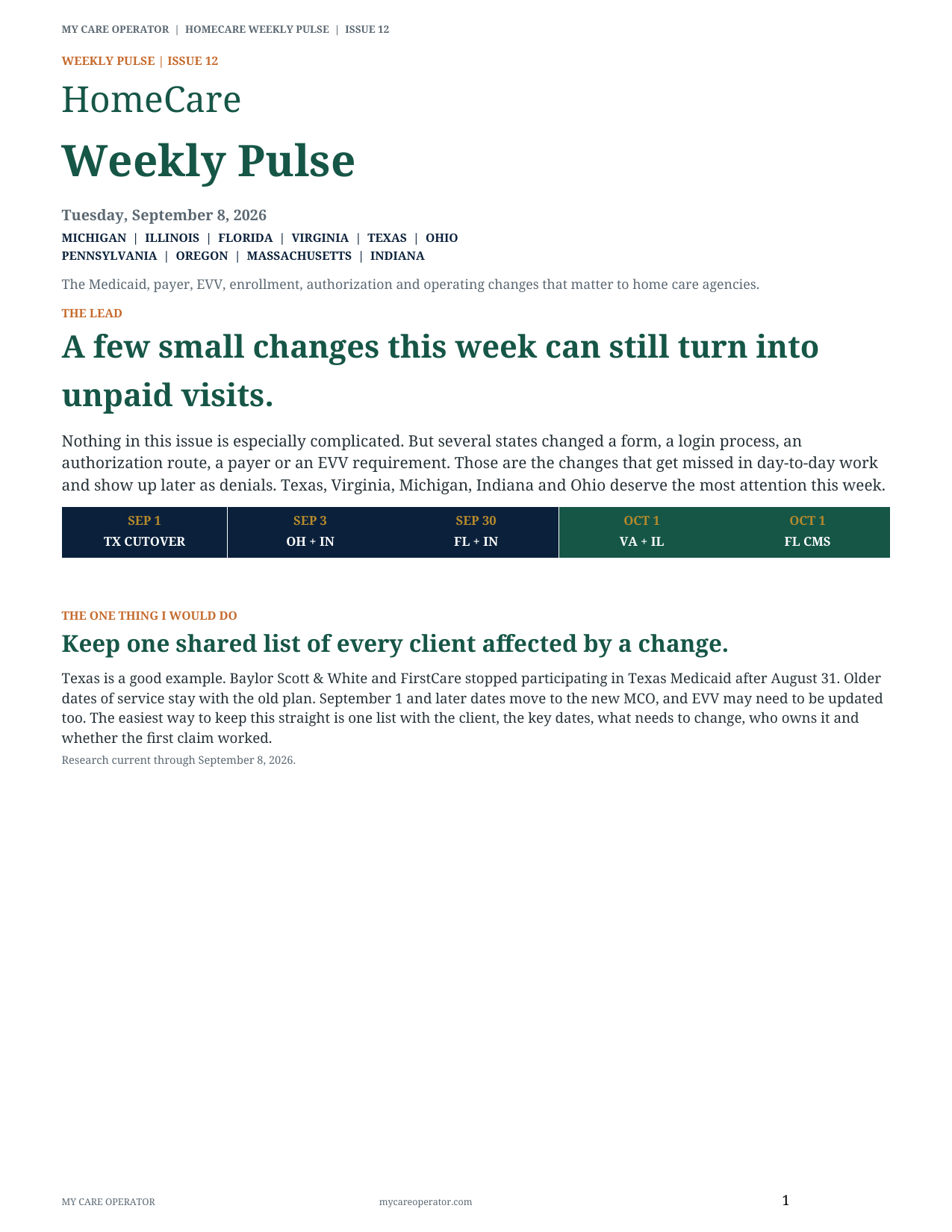
A few small changes this week can still turn into unpaid visits.
Nothing in this issue is especially complicated. But several states changed a form, a login process, an authorization route, a payer or an EVV requirement. Those are the changes that get missed in day-to-day work and show up later as denials.
Texas, Virginia, Michigan, Indiana and Ohio deserve the most attention this week.
The one thing I would do: keep one shared list of every client affected by a change. Put the client, the effective date, what has to change, who owns it and whether the first new transaction worked on that list.
When something changes, put the affected clients on one list.
Most transition problems are simple. Billing has one date. Authorization has another. EVV was never updated. Or everyone thought someone else owned the change. A shared transition list prevents a lot of that. It does not need to be fancy.
1 · Client + program
Name the client, service, program and current payer.
Write down
Keep one row for each client/service combination that is actually affected.
Why
It keeps the change from getting lost between departments.
2 · Key dates
Write down the last date under the old setup and the first date under the new one.
Write down
Keep filing and appeal deadlines in their own fields.
Why
It keeps the change from getting lost between departments.
3 · Authorization
Note whether the current authorization stays valid and whether a new one is needed.
Write down
Put the owner and due date on the same row.
Why
It keeps the change from getting lost between departments.
4 · System changes
List any payer code, EVV authorization, portal, clearinghouse or login change.
Write down
Do not assume a vendor changed it automatically.
Why
It keeps the change from getting lost between departments.
5 · Owner + result
Put one person on it.
Write down
Keep the item open until the first new transaction clears and the claim pays.
Why
It keeps the change from getting lost between departments.
Keep it simple
One list. One owner. One status. The point is to keep the change from getting lost between intake, authorization, EVV and billing.
Six simple steps when a payer or rule changes.
You do not need a new committee or a complicated project plan. You need to know who is affected, what date the change starts and whether the new setup actually works.
Identify the clients and services the change actually affects.
Separate dates of service before and after the effective date.
Verify eligibility, payer and authorization using the current state or payer source.
Make the payer, EVV, portal, clearinghouse or login changes that are required.
Check the first new EVV record, eligibility response or claim acknowledgement. Save the proof.
Do not close the item just because setup is done. Watch the first claim through payment.
Texas is a good live example.7
Baylor Scott & White and FirstCare stopped participating in Texas Medicaid managed care effective September 1. Dates of service through August 31 stay with the old plans, and TMHP says providers have 95 days to submit those claims. September 1 and later dates move to the member's new MCO. For EVV-required services, the new MCO and authorization also need to be reflected in EVV.
That is exactly the kind of change that belongs on one shared list.
MICHIGAN — HHAeXchange users are moving to MiLogin. 1
Who this affects: HHAeXchange Payer and Provider Agency Portal users, plus certain Services Portal users.
Michigan says HHAeXchange Portal users will have to access the portal through MiLogin during September. Most payer and provider agency users should use MiLogin for Business. Certain employer-of-record users use MiLogin for Citizens. The notice does not give one exact cutover date, so this is worth testing now.
- Have each user sign in through the correct MiLogin account and make sure the existing HHAeXchange credentials work.
- Make one person responsible for portal access and user problems.
- Keep this separate from last week's HHAeXchange+ mobile-app MFA change. They are two different login changes.
ILLINOIS — Some Medicaid members may lose full coverage October 1. 2
Who this affects: Members affected by the new federal noncitizen Medicaid eligibility rules.
HFS says federal eligibility changes take effect October 1 for many noncitizens. Some members have been told that their current Medicaid health plan will end September 30, and HFS is sending more notices in September. Agency staff do not need to interpret immigration rules. They do need to check the official eligibility and payer record for clients who may be affected.
- For clients flagged by an official notice or eligibility check, verify eligibility and payer before October 1 and again after October 1.
- Use the state's eligibility record, plan data and the member notice. Do not ask billing or scheduling staff to decide immigration status.
- Escalate any coverage or payer change before the next affected visit.
FLORIDA — Florida is taking comments on FD Waiver rates through September 30. 34
Who this affects: Familial Dysautonomia Waiver providers. The CMS Plan change is separate.
AHCA has proposed changes to Familial Dysautonomia Waiver rates, the rate-setting method and transportation language. Comments are open through September 30. This is not a statewide home-care rate change. Separately, current CMS Plan members are still scheduled to move to Molina on October 1.
- If you serve the FD Waiver, review the proposed rate and transportation changes against what you are doing today.
- If the proposal creates a real cost or access problem, submit a specific comment by September 30.
- If you serve CMS Plan members, keep the October 1 Molina transition on a separate client list.
VIRGINIA — Use the new CCC Plus forms by October 1. 5
Who this affects: CCC Plus Waiver providers, including personal care, private duty nursing, respite and services facilitation.
DMAS updated the CCC Plus Waiver Provider Manual on September 2 and revised the DMAS-97A/B Plan of Care and DMAS-99 assessment forms. Providers must use the new versions no later than October 1. DMAS says older versions submitted after that date can result in a service authorization denial.
- Replace the old DMAS-97A/B and DMAS-99 forms in shared drives, EHRs, intake packets and authorization folders now.
- Tell the staff or vendor that prepares authorization packets about the October 1 deadline.
- Review anything already in progress that may be submitted on or after October 1.
TEXAS — Texas has two live changes to watch. 67
Who this affects: EVV-required services statewide, plus members moving from Baylor Scott & White or FirstCare Medicaid plans.
First, the allowed share of EVV transactions using alternative devices dropped from 75% to 50% on September 1. Second, Baylor Scott & White and FirstCare ended Texas Medicaid participation after August 31. TMHP says dates of service through August 31 stay with the old plan and have a 95-day submission window. September 1 and later claims under those old plans will be rejected.
- Run the EVV Usage Report and make sure alternative-device use is below 50%.
- Separate August 31-and-earlier dates from September 1-and-later dates for members who changed plans.
- For EVV-required services, confirm the new MCO and authorization are in EVV before billing the new plan.
OHIO — PDN authorization routing changed September 3. 8
Who this affects: Private duty nursing across FFS, PASSPORT, DODD waivers, Ohio Home Care Waiver and managed care.
Ohio's new rule 5160-12-02.3 took effect September 3. Where the PDN authorization goes now depends on the member. FFS non-waiver and PASSPORT requests go to ODM. DODD waiver requests start with the county board SSA. Ohio Home Care Waiver requests start with the waiver case manager. Managed-care providers follow the MCO process. The rule also covers emergency PDN.
- Make sure each PDN client is tied to the correct authorization route.
- Do not use one generic PA process for every PDN case.
- Update the emergency-PDN procedure so staff know what has to be documented and who must be notified.
PENNSYLVANIA — Check this week's PROMISe RA for date-of-death recoveries. 9
Who this affects: PROMISe providers, except provider type 07.
Pennsylvania posted a September 7 remittance-advice alert after an audit found date-of-death discrepancies. DHS recovered claims where the eligibility record showed the member died before the billed date of service. The alert explains which ICNs are affected and what to do if the death date is wrong or the service actually occurred before the recorded death date.
- Check the current RA for these recovery adjustments.
- Compare the billed date of service with the official date-of-death record before writing anything off or rebilling.
- If the death date is wrong, contact the county assistance office. If the service was before the death date, correct and resubmit the claim.
INDIANA — Storm-related billing relief is available, but you have to request it. 10
Who this affects: IHCP fee-for-service and managed care cases affected by the August severe storms and flooding.
IHCP Bulletin BT2026147 gives temporary billing and authorization flexibility through November 30 for disaster-related disruptions. Retrospective authorization may be accepted when submitted within 60 calendar days of the date of service. Timely-filing relief is separate. It has to be requested and supported; it is not automatic.
- Put affected cases on a separate disaster list with the member, date of service, problem and supporting documentation.
- Submit retrospective authorization as soon as possible. Do not wait for the November 30 end date.
- If you need timely-filing relief, use the required claim note and attach documentation. Do not assume the deadline was waived.
MASSACHUSETTS — MassHealth has a new Provider Handbook. 12
Who this affects: All MassHealth providers. Service-specific manuals, regulations and bulletins still control.
MassHealth announced a new Provider Handbook on September 1. It looks useful as a starting point for finding processes and resources. It is not a replacement for the service-specific manual, regulation, transmittal or payer instruction that actually controls the claim.
- Add the handbook to the team's approved resource list.
- Use it to find the right rule or process, then verify the source that actually governs the service.
- Do not rewrite an HHA or LTSS procedure based only on a handbook summary.
OREGON — No major statewide home-care billing change this week. 13
Who this affects: Oregon Health Plan Medicaid LTSS and in-home services.
I did not find a new broad statewide home-care billing, EVV or authorization change in the official Oregon provider updates reviewed for September 1-8. There is nothing here that should cause an agency to rewrite its workflow this week.
- Keep current eligibility, authorization, EVV and claim exceptions moving.
- Ignore notices that do not apply to your provider type or program.
- Keep watching OHA Provider Matters and the OHP provider portal for a material change.
These are worth putting on the calendar.
If I were running the billing operation, these are the things I would make sure happened this week.
Test MiLogin access now instead of waiting for the HHAeXchange cutover.
Separate old-plan and new-plan dates of service and make sure EVV is updated.
Remove the old CCC Plus forms before October authorization work is submitted.
Build an October 1 eligibility recheck list for clients who may be affected.
Track storm-related authorization and timely-filing requests separately.
Check the current RA for date-of-death recoveries.
Make sure every PDN case is going through the right authorization path.
If applicable, review the FD Waiver proposal and keep CMS Plan transition work separate.
The practical point
Most of this week is ordinary operational stuff. That is why it gets missed.
A form changes. A payer changes. A login changes. An authorization goes to a different place. None of that is hard by itself. The problem is when the change sits between departments and nobody notices until the claim comes back. Give each item an owner and watch the first claim after the change. That is enough.
Which of these changes actually affects your agency this week?
— JB
Julio Barea · Publisher & Editor · My Care Operator
For news, educational and informational purposes only. Not legal, financial, tax, clinical, billing, regulatory or compliance advice. Operator actions are editorial recommendations, not official agency instructions. Verify material requirements with governing authorities, payers, contracts and qualified advisers.
1. Michigan MDHHS, HHAeXchange Electronic Visit Verification Portal Access is Moving to MiLogin.
2. Illinois HFS, Health Benefits for Immigrants / Medicaid eligibility changes.
3. Florida AHCA, Familial Dysautonomia Waiver amendment and public comment period.
4. Florida AHCA, CMS Plan Transition.
5. Virginia DMAS, CCC Plus Waiver Provider Manual and forms update.
6. Texas TMHP, EVV Alternative Device Reduction Schedule.
7. Texas TMHP, Baylor Scott & White and FirstCare claim filing update.
9. Pennsylvania DHS, PROMISe Remittance Advice Alerts / Date of Death Recovery.
10. Indiana IHCP Bulletin BT2026147, temporary billing and authorization flexibilities for August storms.
11. Indiana IHCP Bulletin BT2026149, rendering provider linkage process.
12. MassHealth, Provider Remittance Advice Message Text - September 2026.
13. Oregon Health Authority, Provider Matters - Updates for OHP Providers.