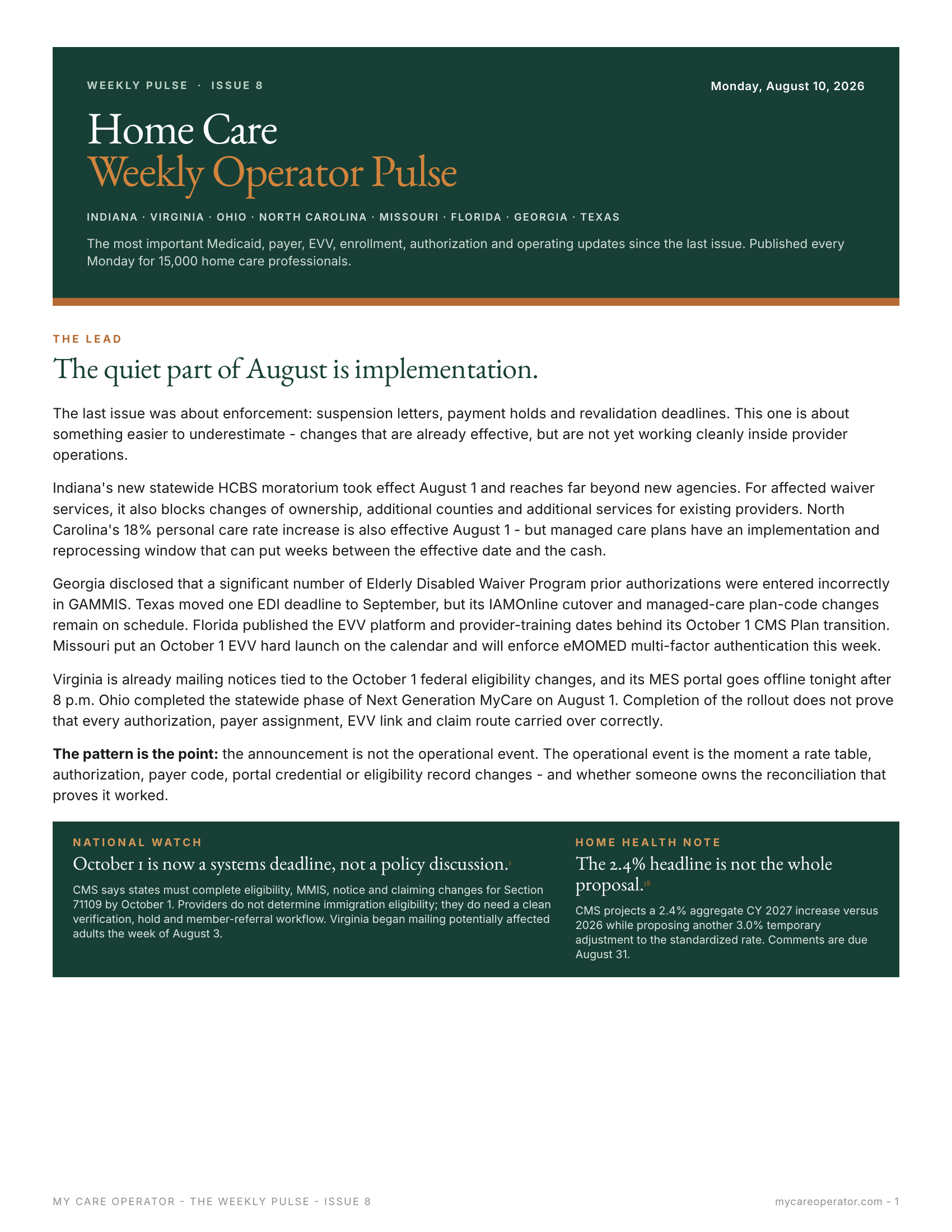
The quiet part of August is implementation.
The last issue was about enforcement: suspension letters, payment holds and revalidation deadlines. This one is about something easier to underestimate - changes that are already effective, but are not yet working cleanly inside provider operations.
Indiana's new statewide HCBS moratorium took effect August 1 and reaches far beyond new agencies. For affected waiver services, it also blocks changes of ownership, additional counties and additional services for existing providers. North Carolina's 18% personal care rate increase is also effective August 1 - but managed care plans have an implementation and reprocessing window that can put weeks between the effective date and the cash.
Georgia disclosed that a significant number of Elderly Disabled Waiver Program prior authorizations were entered incorrectly in GAMMIS. Texas moved one EDI deadline to September, but its IAMOnline cutover and managed-care plan-code changes remain on schedule. Florida published the EVV platform and provider-training dates behind its October 1 CMS Plan transition. Missouri put an October 1 EVV hard launch on the calendar and will enforce eMOMED multi-factor authentication this week.
Virginia is already mailing notices tied to the October 1 federal eligibility changes, and its MES portal goes offline tonight after 8 p.m. Ohio completed the statewide phase of Next Generation MyCare on August 1. Completion of the rollout does not prove that every authorization, payer assignment, EVV link and claim route carried over correctly.
The pattern is the point: the announcement is not the operational event. The operational event is the moment a rate table, authorization, payer code, portal credential or eligibility record changes - and whether someone owns the reconciliation that proves it worked.
October 1 is now a systems deadline, not a policy discussion.1
CMS says states must complete eligibility, MMIS, notice and claiming changes for Section 71109 by October 1. Providers do not determine immigration eligibility; they do need a clean verification, hold and member-referral workflow. Virginia began mailing potentially affected adults the week of August 3.
The 2.4% headline is not the whole proposal.18
CMS projects a 2.4% aggregate CY 2027 increase versus 2026 while proposing another 3.0% temporary adjustment to the standardized rate. Comments are due August 31.
North Carolina's 18% rate increase is not 18% more cash this week.2
North Carolina applied an 18% increase to applicable Personal Care Services rates effective August 1 across NC Medicaid Direct and CAP/C, CAP/DA and CAP/CD. The state says $70.8 million in recurring state funding was distributed uniformly across the applicable codes for the remaining 11 months of state fiscal year 2027.
The increase is material. State Plan PCS code 99509 moved from $5.96 to $7.03. CAP/CD codes T1004 and T1019 moved from $7.34 to $8.66. S9122 with TF or TG moved from $5.44 to $6.42. But the revenue-operations problem is not whether the new rates exist. It is proving that each payer loaded, adjudicated and paid them correctly.
Applicable HA/HB and listed setting modifiers.
New rate effective for dates of service on or after August 1.
Applies to both TF and TG modifiers.
For managed care, the bulletin gives health plans 45 calendar days from DHB notification to load the new rates, plus 30 additional days to reprocess claims with dates of service on or after August 1. That creates four different dates an agency must not confuse: the policy effective date, the payer configuration date, the adjudication date and the date the additional cash arrives.
Agencies should not assume the first August remittance is wrong merely because it reflects the old rate, and they should not reflexively rebill a correctly submitted claim unless the plan instructs them to do so. The right control is an expected-payment model and an underpayment log that remains open until the plan's reprocessing is complete.
The policy and new fee schedule begin. This does not prove each plan's system is ready.
Managed-care plans receive time to load the new rates into their payment systems.
Plans receive more time to reprocess August 1-and-later claims paid at the prior rate.
- Build a payer-by-payer crosswalk for every affected code and modifier: old rate, new rate, effective date, contract method and expected allowed amount.
- Tag every managed-care claim with an August 1 or later date of service and compare the remittance to the expected new rate.
- Log short payments by plan, code, modifier, date of service and dollar variance. Do not bury the difference in a generic contractual adjustment.
- Keep the variance open through the plan's stated loading and reprocessing window. Escalate after that window with a clean claim-level schedule.
- Do not commit the full increase to permanent labor cost until the agency sees how consistently the increase is actually paid across its payer mix.
INDIANA - The HCBS growth freeze is live.3
Indiana's statewide certification and enrollment moratorium took effect August 1 for a broad set of 1915(c) waiver services across PathWays, Health and Wellness, TBI, Community Integration and Habilitation, and Family Supports. The initial term is six months and can be extended in six-month increments.
This is not limited to brand-new agencies. For affected services, the moratorium also prevents changes of ownership, adding counties and adding services for existing HCBS agencies. Open enrollment applications that had not completed screening before August 1 are to be denied. Certification treatment varies by waiver and application status, including expiration of some pending applications and holding some provisional approvals.
Indiana allows limited exceptions where member access is at risk, but the provider must meet qualifications and submit a narrative explaining the access concern it can solve. That is an access exception, not a routine expansion lane.
- Freeze any acquisition, county-expansion or service-line plan that assumes an affected enrollment can be added during the moratorium.
- Identify every pending application and document its exact status on July 31; do not describe an application as "in process" without knowing which treatment applies.
- Use the exception path only when you can demonstrate a specific member-access gap and satisfy all provider qualifications.
NORTH CAROLINA - The rate is effective. The cash will lag.2
See the case study above. The 18% PCS increase is real and effective August 1, but managed-care payment may lag while plans load rates and reprocess eligible claims. Treat the variance as a controlled receivable, not an immediate write-off and not guaranteed cash on the next remit.
The separate off-cycle provider reverification announced in July remains a live carry-forward item. Continue monitoring the NCTracks secure Provider Message Inbox rather than waiting for an email to reach the right person.
- Separate fee-for-service and managed-care implementation tracking.
- Make one named person responsible for the rate-variance log and another responsible for monitoring NCTracks messages.
GEORGIA - Bad PA data is now a billing workflow.4
DCH says a significant number of EDWP prior authorizations were entered incorrectly into GAMMIS. The majority have now been processed, but remaining errors can still block billing. DCH also published the order of operations providers should follow: first the assigned Gainwell Provider Representative, then the member's case management agency, and only after initial troubleshooting should the case management agency submit a technical support ticket to DCH.
That sequence matters. A generic "GAMMIS is wrong" escalation without claim, member, authorization and troubleshooting detail will move more slowly than a controlled exception packet.
- Run an EDWP authorization-to-schedule-to-claim exception report before each claim cycle.
- For each blocked claim, retain the member, service, authorization span, units, GAMMIS evidence, Gainwell contact and case-management response in one file.
- Confirm August authorizations are loaded before treating delivered visits as billable.
VIRGINIA - Tonight's outage is immediate. The eligibility change is next.567
The Virginia MES portal and ISS login are scheduled to be unavailable after 8 p.m. tonight, August 10, with service expected to resume Tuesday morning. Complete time-sensitive portal work before the outage rather than discovering at 8:05 p.m. that a Monday close task depends on access.
Separately, direct access to Atrezzo Next Generation ended July 31. Effective August 1, fee-for-service providers must use DMAS Identity, Credentials and Access Management through MES to reach Atrezzo for service authorization requests. Missing the ANG tile is now an access exception that must be resolved through MES Assist.
Virginia also began mailing notices the week of August 3 to adults who may be affected by the October 1 federal noncitizen eligibility changes. The state says children's and pregnant/postpartum eligibility rules are not changing under this action, and emergency-services coverage may remain available for some people who lose full benefits.
- Finish Monday portal work before 8 p.m. and verify Tuesday morning that scheduled submissions actually completed.
- Test every staff member's MES-to-Atrezzo access now; document who owns service-authorization backup coverage.
- Give intake, scheduling and billing teams a neutral script: do not interpret eligibility letters; verify the official record and route the member to Virginia Medicaid resources.
TEXAS - One deadline moved. Two cutovers did not.891011
TMHP moved its EDI connectivity change from August 1 to September 1. That gives affected batch submitters another month to replace VPN connectivity with the supported SFTP process. It does not change the August 24 IAMOnline release or the September 1 payer changes for Baylor Scott & White and FirstCare STAR members.
IAMOnline: LTC Online Portal, LTC Dashboard, EVV Portal and Care Forms move to IAMOnline on August 24. A second activation email is scheduled for August 18, and the activation link expires after seven days. MFA is required. Effective August 24, accounts and individual applications can be deactivated after 90 days of inactivity.
Outage: the August maintenance window was rescheduled to 2 p.m. Sunday, August 23 through 4 a.m. Monday, August 24 Central. All web-based applications and functions are unavailable during the window. That outage ends as Release 4 goes live.
MCO/EVV transition: Baylor Scott & White and FirstCare leave STAR after August 31. Plan codes 50, W4 and C3 end that day. For September 1 dates of service, providers must identify the member's new MCO and plan code, create a new authorization in EVV using the new code, manually enter it, and notify any third-party billing vendor.
- Keep the EDI project active despite the delay. Confirm testing, SFTP credentials, ownership and a September 1 go/no-go checkpoint.
- Inventory every IAMOnline user, application and backup login. Activate within seven days of the August 18 email and log into each required application.
- Treat August 23-24 as a controlled outage. Submit and verify priority work before Sunday afternoon, then run an access check Monday morning.
- Build a member-level crosswalk for every affected BSW/FirstCare member: old plan code, new MCO, new plan code, authorization status, EVV entry and first claim date.
FLORIDA - The CMS Plan transition now has dates, training and an EVV platform.121314
The October 1 transition of Florida's Children's Medical Services Plan from Sunshine Health to Molina is moving from general notice into operational onboarding. Molina says HHAeXchange will support authorization management, scheduling, EVV and billing for the CMS Plan beginning October 1. A live Molina/HHAeXchange town hall is scheduled for August 13 at 11 a.m. Eastern.
Molina also released an updated provider-training calendar. General CMS Plan onboarding is August 19; Home Health provider training is August 24; PDN/FHHA training is September 3, with additional sessions later. Providers who registered for an earlier orientation are instructed to re-register using the updated schedule.
Current CMS members transition automatically and existing authorizations are to be honored during continuity of care. But provider network participation is a separate issue: Molina is accepting network applications, and providers should verify contracting, credentialing, roster data, claims setup and HHAeXchange linkage before go-live.
- Register the operational owners - not just executives - for the August 13 town hall and the provider-specific training that applies.
- Build one transition tracker covering contract, credentialing, roster, authorization, HHAeXchange, claim submission and first-payment validation.
- Do not confuse continuity of care with completed network readiness. Existing authorizations can be honored while a contracting or system setup problem still blocks clean payment.
MISSOURI - Two access controls arrive before the EVV hard launch.1516
Missouri tentatively scheduled the third EVV hard-launch phase for October 1 for provider type 85 services furnished through DMH Division of Developmental Disabilities and the Brain Injury Waiver. After hard launch, claims without an active EVV vendor and verified visits in EAS will be automatically denied.
The state also warns that participants do not automatically transfer between provider IDs. Agencies operating multiple IDs or provider types must ensure participant lists reach each separate EAS account and must confirm visits are verified before billing.
Before that, eMOMED begins enforcing multi-factor authentication on August 15. Users who have not registered SMS, email or an authenticator method risk finding out at the login screen.
- Require every eMOMED user to complete MFA registration and a successful test login before August 15.
- For provider type 85, reconcile participants by provider ID and confirm active vendor status plus verified visits in every EAS account.
- Run EAS reconciliation before each claim submission now; do not wait for October 1 to make it a control.
OHIO - MyCare is statewide. Now reconcile what did not carry cleanly.17
Phase 2 of Next Generation MyCare reached the rest of Ohio through August 1, completing the statewide rollout. Ohio Medicaid's final all-provider webinar in the current series is scheduled for August 19.
This week should be treated as post-cutover reconciliation: compare member assignments, prior authorizations, claims routing, EVV interfaces, portal access, ERA/EFT and credentialing against the pre-conversion record. A rollout can be complete statewide while individual provider exceptions remain unresolved.
- Bring a claim-level and member-level exception log to the August 19 webinar rather than general questions.
- Keep the existing enrollment moratorium and statewide revalidation controls active; the MyCare milestone does not replace them.
Put these on the operating calendar now.
Every change needs one person accountable for the rate, portal, authorization, payer or eligibility implementation.
Decide what proves completion: successful login, loaded rate, verified visit, valid authorization, accepted claim or correct remit.
Do not wait for denials. Compare the new state to the expected state before the claim cycle closes.
Document who receives the issue, what evidence goes with it and when it moves to the next level.
A bulletin read, training attended or ticket submitted is activity. Correct payment and stable workflow are completion.
Implementation is the work.
External changes create internal risk only when nobody turns them into an owner, a control, an exception report and proof of completion.
The industry is entering a period where multiple changes are technically "live" at the same time: enrollment freezes, rate updates, system migrations, EVV edits, payer transitions and eligibility redeterminations.
The agencies that protect cash will turn every external change into an internal owner, a date, a control, an exception report and proof that the new workflow actually reached payment.
Which transition is creating the most operational friction in your state right now: enrollment, eligibility, EVV, authorization, payer change or rate implementation?
- JB
Julio Barea · Publisher & Editor · My Care Operator · mycareoperator.com
For news, educational and informational purposes only. Not legal, financial, tax, clinical, billing, regulatory or compliance advice. Operator actions are editorial recommendations, not official agency instructions. Verify material requirements with governing authorities, payers, contracts and qualified advisers.
1. CMS, Section 71109 State Implementation Tool, July 31, 2026.
2. NC Medicaid, Updates to Rate Increase for PCS and CAP, Aug. 4, 2026.
3. IHCP Bulletin BT2026124, HCBS Provider Certification and Enrollment Moratorium, July 23, 2026.
4. Georgia DCH, Georgia Horizons Update, July 27, 2026.
5. Virginia MES Provider Portal notice, accessed Aug. 9, 2026.
6. Virginia DMAS, Direct Access to Atrezzo Ending, effective Aug. 1, 2026.
7. Virginia DMAS, Information for Noncitizens, accessed Aug. 9, 2026.
8. TMHP, IAMOnline and MFA Release 4, July 3, 2026.
9. TMHP, August Maintenance Schedule Updated, July 27, 2026.
10. TMHP, EDI Connectivity Change Rescheduled, updated Aug. 7, 2026.
11. TMHP, EVV Impacts of BSW/FirstCare STAR Exit, July 21, 2026.
12. Molina Florida, HHAeXchange Implementation and Town Hall, Aug. 3, 2026.
13. Molina Florida, CMS Plan Training Schedule, Aug. 4, 2026.
14. Molina Florida, CMS Transition FAQs; Florida AHCA, CMS Plan Transition.
15. MO HealthNet, EVV Hard Launch Preparation, July 27, 2026.
16. MO HealthNet, Mandatory MFA for eMOMED, July 27, 2026.
17. Ohio Medicaid, Next Generation MyCare Program, accessed Aug. 9, 2026.
18. CMS, CY 2027 HH PPS Proposed Rule Fact Sheet; CMS-1844-P rule page.
19. Florida AHCA, ICMC Waiver Amendment Public Notice, July 30-Aug. 28, 2026.