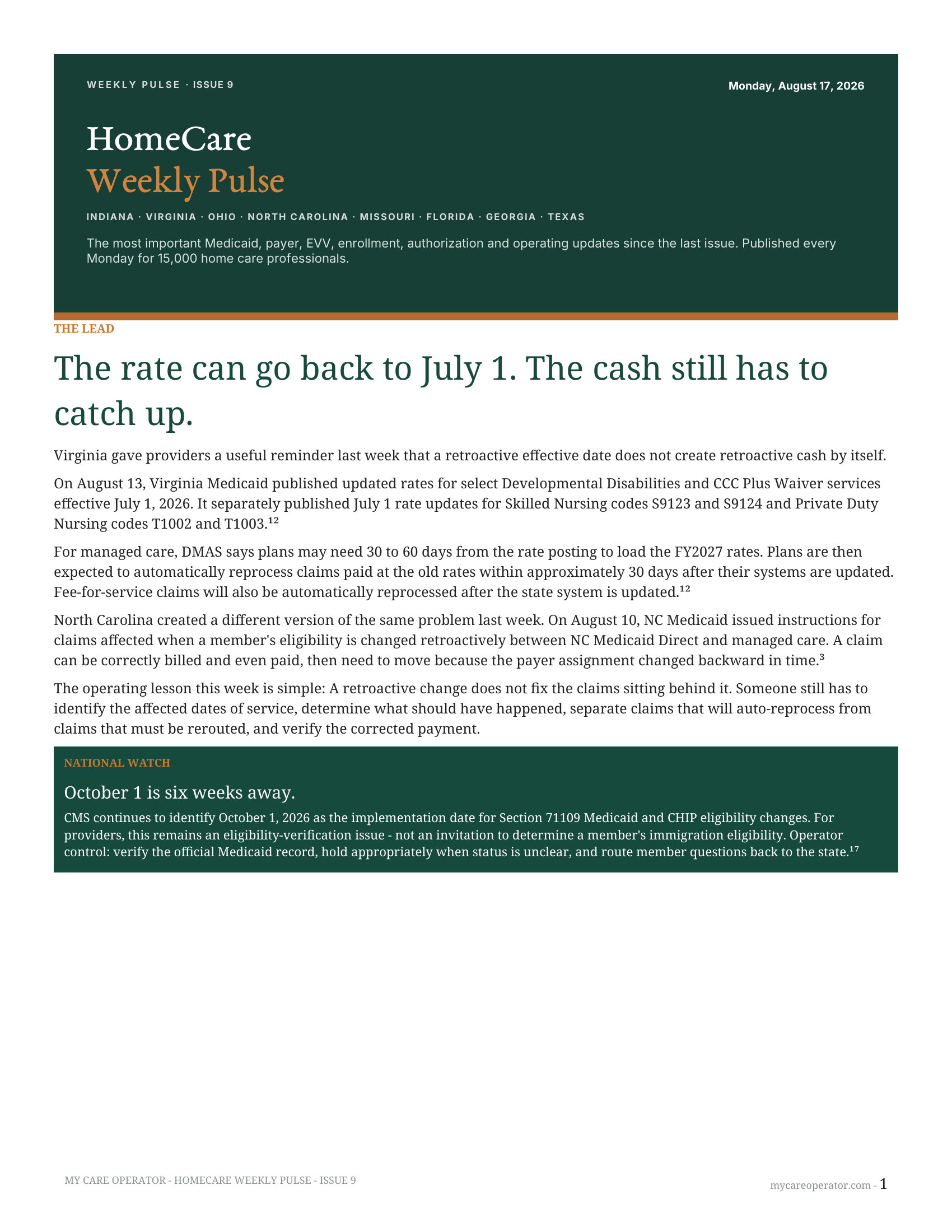
The rate can go back to July 1. The cash still has to catch up.
Virginia gave providers a useful reminder last week that a retroactive effective date does not create retroactive cash by itself.
On August 13, Virginia Medicaid published updated rates for select Developmental Disabilities and CCC Plus Waiver services effective July 1, 2026. It separately published July 1 rate updates for Skilled Nursing codes S9123 and S9124 and Private Duty Nursing codes T1002 and T1003.12
For managed care, DMAS says plans may need 30 to 60 days from the rate posting to load the FY2027 rates. Plans are then expected to automatically reprocess claims paid at the old rates within approximately 30 days after their systems are updated. Fee-for-service claims will also be automatically reprocessed after the state system is updated.12
North Carolina created a different version of the same problem last week. On August 10, NC Medicaid issued instructions for claims affected when a member's eligibility is changed retroactively between NC Medicaid Direct and managed care. A claim can be correctly billed and even paid, then need to move because the payer assignment changed backward in time.3
The operating lesson this week is simple: A retroactive change does not fix the claims sitting behind it. Someone still has to identify the affected dates of service, determine what should have happened, separate claims that will auto-reprocess from claims that must be rerouted, and verify the corrected payment.
October 1 is six weeks away.17
CMS continues to identify October 1, 2026 as the implementation date for Section 71109 Medicaid and CHIP eligibility changes. For providers, this remains an eligibility-verification issue—not an invitation to determine a member's immigration eligibility.
Verify the official record.
Hold appropriately when status is unclear and route member questions back to the state.
Virginia posted July 1 rates on August 13. Build the receivable now.12
The July 1 effective date matters. So does August 13.
Virginia Medicaid's new waiver, Skilled Nursing and Private Duty Nursing rates reach backward to services already delivered and, in many cases, claims already adjudicated.
For affected managed-care claims, DMAS says plans may need 30–60 days after the rates are posted to finish updating their systems. Claims previously paid using the old rates are then expected to be automatically reprocessed within approximately 30 days after the system update. Providers currently have the option to continue billing MCOs at the old rate or delay billing until the updated rates are loaded.
New reimbursement applies to eligible dates of service.
The update is public and the implementation clock is visible.
Managed-care plans may still be loading the new rates.
Prior old-rate claims are expected to reprocess after configuration.
Verify corrected remittance and additional cash before closing.
- Find the population. Identify every affected code, payer, location and date of service beginning July 1.
- Separate the lanes. Split fee-for-service from managed-care claims and distinguish paid claims from unprocessed claims.
- Calculate the expected difference. Build the claim- or service-line variance between the prior and updated rate.
- Do not rebill reflexively. A correctly submitted claim that is expected to auto-reprocess should not be duplicated just because the old rate paid.
- Keep the variance open. Close only when the corrected remittance and cash reconcile to the expected amount.
- Confirm enrollment readiness. Payment depends on appropriate enrollment and current information in Virginia Provider Services Solution.
The control is proving that your claims did.
VIRGINIA — July claims now need a rate reconciliation.12
Virginia's July 1 waiver, Skilled Nursing and Private Duty Nursing rate changes are now published, but managed-care implementation can continue well beyond the publication date.
- Build the July 1-and-later claim population now. Do not wait for plans to finish reprocessing before determining what you expect to collect.
- Assign one person to own the expected-payment file and require claim-level reconciliation before the project is considered complete.
NORTH CAROLINA — A retroactive eligibility change can move the claim.34
NC Medicaid published new guidance August 10 for claims affected by retroactive eligibility changes.
When eligibility is retroactively changed from NC Medicaid Direct or another health plan to a new managed-care plan, providers should contact the newly responsible plan to determine how affected claims must be submitted. If a managed-care plan recoups a previously paid claim because the member is retroactively moved back to NC Medicaid Direct, the provider must submit the claim to NC Medicaid Direct within 180 days of the recoupment date and include documentation showing the recoupment and evidence the original claim was filed timely.
The separate 18% PCS rate increase effective August 1 also remains inside the managed-care loading and reprocessing window. It stays in the Pulse because the money is still being reconciled—not because the announcement is new.
- Create a standard retro-eligibility packet containing the original claim, original payer, payment or denial evidence, eligibility history, recoupment documentation and the new payer-routing instruction.
- Keep PCS rate variances open until each plan completes its implementation and the expected payment is confirmed.
TEXAS — The activation email arrives tomorrow. The cutover is next Monday.5678
TMHP's second IAMOnline activation email is scheduled for August 18. Providers have seven days after receiving the activation link to complete account activation, password setup and MFA registration.
TMHP's system-maintenance outage begins Sunday, August 23 at 2 p.m. Central and runs until 4 a.m. Monday, August 24. On August 24, the LTC Online Portal, LTC Dashboard, EVV Portal and Care Forms move into IAMOnline. September 1 remains the next cutover for affected batch EDI submitters and BSW/FirstCare STAR members.
- Do not manage these as separate emails. Build one Texas cutover tracker covering IAMOnline activation, MFA, outage preparation, EDI/SFTP readiness, affected members, new MCO assignment, EVV authorization, billing-vendor notification and the first clean September claim.
- Treat this as a seven-day operating project with one accountable owner.
FLORIDA — Training moves from calendar item to readiness test.9
Molina's Children's Medical Services Plan goes live October 1, and the provider-training sequence is now underway. Molina lists General CMS Plan & Provider Onboarding on August 19, Home Health Provider Training on August 24, and PDN/FHHA training on September 3. Molina's CMS Plan materials also include HHAeXchange implementation resources.
The mistake now would be to treat training attendance as implementation.
- The person attending training should leave with unresolved items assigned to named owners.
- For home care agencies, the transition tracker should at minimum address network participation, credentialing, roster information, authorizations, HHAeXchange readiness, claims setup and first-payment validation.
- October 1 is the go-live. The agency's internal deadline needs to be earlier.
GEORGIA — August residency letters can become eligibility exceptions.1011
Georgia DCH says it will mail Medicaid residency-verification correspondence in August and October 2026 to select members reported as receiving Medicaid benefits in Georgia and another state. DCH asks affected members to respond immediately.
For a home care agency, the important issue is not interpreting the letter. It is recognizing that an eligibility question may be developing before it reaches scheduling or billing.
The EDWP prior-authorization issue from the previous Pulse remains relevant only for agencies that still have unresolved claims or authorizations.
- Train intake and scheduling staff to recognize residency-verification correspondence without trying to determine eligibility themselves.
- If a member reports receiving a letter, direct the member to respond to DCH and verify official Medicaid status before making coverage-dependent billing decisions.
- For EDWP, carry forward only unresolved exceptions. If the authorization is fixed and the claim is paying correctly, close it.
MISSOURI — Test access now. Build the EVV control before October.121314
MO HealthNet's eMOMED MFA implementation is now in its August enforcement period. Users have been instructed to select and register an MFA method rather than relying on the old login process.
Missouri's third EVV hard-launch phase is tentatively scheduled for October 1 for affected services delivered through the Department of Mental Health Division of Developmental Disabilities and Brain Injury Waiver personal care services under provider type 85. After hard launch, claims without an active EVV vendor and verified visits in EAS are expected to deny automatically.
Missouri is also running an off-cycle provider revalidation initiative. Selected Adult Day Care providers are in the first phase with an October 1 deadline; Home Health and Private Duty Nursing fall into the later Phase II cycle.
- Test every required eMOMED user now—including backup users.
- For affected EVV services, reconcile active vendor status, participant assignment and verified visits before claim submission now instead of waiting for October.
- If your agency received an off-cycle revalidation notice, the notice becomes a controlled enrollment deadline. Do not leave it sitting in a generic administrative inbox.
OHIO — Wednesday's webinar should be an exception-resolution meeting.15
Next Generation MyCare is now operating statewide, and Ohio Medicaid's final provider webinar in the current rollout series is scheduled for Wednesday, August 19.
There is little value in bringing another general question about the transition.
- Bring actual exceptions: member assignment problems, missing or incorrect authorizations, payer-routing issues, EVV mismatches, portal-access failures, claims that did not cross correctly, ERA/EFT problems or unresolved credentialing issues.
- Document the answer, assign an owner and set an escalation date after the webinar.
INDIANA — The moratorium is still an operating constraint.16
Indiana's statewide HCBS provider certification and enrollment moratorium remains effective for affected 1915(c) waiver services. It began August 1 and has an initial six-month term.
There is no reason to repeat last week's full explanation. What matters now is whether an agency is making a business decision that runs into it.
- Keep acquisition, change-of-ownership, county-expansion and service-expansion plans from moving forward on the assumption that an affected enrollment can simply be added later.
- If the business case depends on an exception, treat approval of that exception as a dependency—not an assumption.
Put these on the operating calendar now.
Retroactive changes need their own queue.
Identify every member, claim and date of service touched by the change.
Know what the eligibility, authorization, rate or payer assignment should now produce.
Do not mix claims waiting for automatic reprocessing with claims requiring rebilling, rerouting, an appeal or another correction.
Keep the original payment, recoupment, eligibility history, authorization and corrected remittance together.
“Will automatically reprocess” describes the payer process. A correct remittance proves your claim completed it.
Retroactivity creates a work queue.
A rate increase can reach backward. So can an eligibility change, payer correction, authorization repair or system conversion. The agency still has to identify the affected claims and prove the corrected result.
Some claims will automatically reprocess. Some must be rerouted. Some need documentation. Some need escalation. And some will appear corrected until somebody compares the new remittance against what should actually have been paid.
The agencies that protect cash will know exactly which claims were affected, what the corrected outcome should be, what path each claim is taking and when the money actually arrives.
Which retroactive change creates the most cleanup in your agency: rates, eligibility, authorizations or payer assignment?
— JB
Julio Barea · Publisher & Editor · My Care Operator · mycareoperator.com
For news, educational and informational purposes only. Not legal, financial, tax, clinical, billing, regulatory or compliance advice. Operator actions are editorial recommendations, not official agency instructions. Verify material requirements with governing authorities, payers, contracts and qualified advisers.
1. Virginia DMAS, Waiver Rate Updates Effective July 1, 2026, Aug. 13, 2026.
2. Virginia DMAS, Private Duty and Skilled Nursing Update Effective July 1, 2026, Aug. 13, 2026.
3. NC Medicaid, Claim Submission Process When Eligibility Is Retroactively Updated, Aug. 10, 2026.
4. NC Medicaid, Updates to Rate Increase for Personal Care Services and the Community Alternatives Program, Aug. 4, 2026.
5. TMHP, New Login Process Through TMHP IAMOnline—Release 4, July 3, 2026.
6. TMHP, Monthly System Maintenance Schedule, 2026.
7. TMHP, EVV Impacts: Baylor Scott & White and FirstCare MCOs End Participation, July 21, 2026.
8. TMHP, EDI Connectivity Change Rescheduled for September 1, 2026, updated Aug. 7, 2026.
9. Molina Healthcare of Florida, CMS Plan Provider Trainings / Children's Medical Services, updated Aug. 2026.
10. Georgia DCH, Georgia Medicaid Member Residency Verification.
11. Georgia DCH, Georgia Horizons Update, July 27, 2026.
12. MO HealthNet, Upcoming Mandatory MFA Implementation for eMOMED.
13. MO HealthNet, Department of Mental Health and Brain Injury Waiver Providers: Be Prepared for EVV Hard Launch, July 27, 2026.
14. Missouri Medicaid Audit & Compliance, Notice of Off-Cycle Revalidation Initiative.
15. Ohio Medicaid, Next Generation MyCare Program, provider webinar information.
16. Indiana FSSA/IHCP, HCBS Provider Enrollment and Certification Moratorium, effective Aug. 1, 2026.
17. CMS, Section 71109 Implementation Materials, 2026.